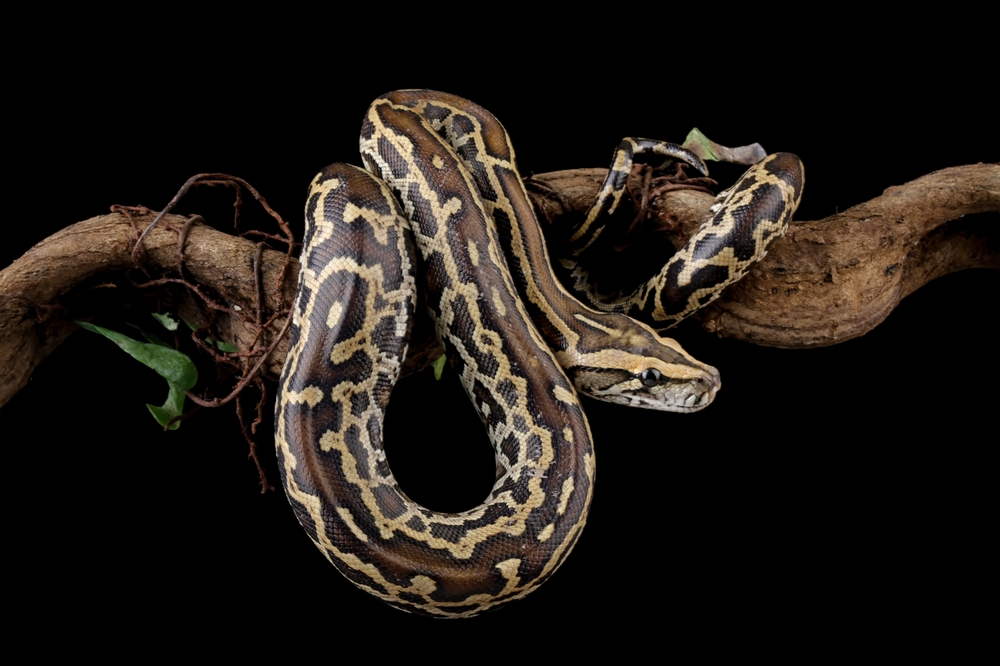
Wildlife officials just confirmed a second Burmese python breeding colony in Florida – this one outside the Everglades entirely.
That colony didn't wander there – it was born there, reproducing in territory scientists never expected them to reach.
And the man who studies this for the University of Florida just admitted they have no way to reverse it.
A Population Nobody Can Count – or Stop
Start with what we actually know.
More than 27,000 Burmese pythons have been removed from Florida's environment since 2000.
That sounds like progress.
It isn't.
Wildlife biologists estimate search teams spot only 1% to 3% of the pythons in any given area.
Do that math.
If hunters and contractors have pulled out 27,000 snakes and they're finding roughly one in every hundred that's out there, the actual population is somewhere between hundreds of thousands and a number nobody wants to say out loud.
A single female lays up to 100 eggs per year.
They have no natural predators in Florida.
https://twitter.com/foxweather/status/2081152521243152655?s=20
They've been reproducing since the mid-1980s.
This is what a biblical-scale ecological disaster looks like before anyone's ready to call it that.
What 40 Years of Unchecked Predators Does to a Landscape
The Everglades used to be full of raccoons – so many that Everglades National Park ran a formal nuisance control program against them in the 1980s.
Raccoon control programs.
Let that sit for a second.
By 2005, park rangers hadn't documented a single nuisance raccoon incident in the southern section of the park.
They didn't become less annoying.
They were gone.
A study spanning 1997 to 2012 found raccoon populations collapsed by 99.3%.
Opossums fell by 98.9%.
Bobcats by 87.5%.
Marsh rabbit sightings in python-dense areas dropped by 100%.
Not declined.
Gone.
https://twitter.com/carolmswain/status/2081407486071128172?s=20
The Florida panther – already one of the most endangered mammals in North America – now competes with a 20-foot apex predator for the same prey that used to sustain it.
This is what happens when irresponsible pet owners dump an Asian constrictor into a subtropical wilderness and walk away.
Charlotte County Is Not the Everglades
Here's the part that should have everyone's attention.
Wildlife officials have now confirmed a separate, established Burmese python breeding population in western Charlotte County – on Florida's Gulf Coast north of Naples and Fort Myers.
This isn't a stray snake that wandered off course.
This is a colony – a reproducing population outside what was always considered the core invasion zone.
And since May 2025, more than a dozen python sightings have been documented in suburban and industrialized areas of South Florida – including a 14-foot snake crossing six lanes of traffic on U.S. 1 through the Miami suburb of Pinecrest at 2 in the morning.
Wildlife biologist Miller put it plainly: the snakes do well in "disturbed areas, like agricultural land and suburban environments."
Robert McCleery, a wildlife ecologist at the University of Florida, was more direct: "This is a pattern we have not yet found a way to stop or reverse at the scales needed to address the problem."
https://twitter.com/DrHoosierHermit/status/2081428776504918092?s=20
The University of Florida's own wildlife ecologist.
No way to stop or reverse it.
The Python Challenge Is Not Enough – But It's What We've Got
The 2026 Florida Python Challenge runs July 10–19, offering $25,000 in prizes.
Last year's competition set a record – 934 participants from 30 states and Canada removed 294 pythons in 10 days.
The 2025 grand prize went to Taylor Stanberry, a Naples-based snake specialist who pulled out 60 pythons and earned $10,000.
That's impressive.
It's also 294 snakes against a population that could be 300,000 strong.
The Florida Fish and Wildlife Conservation Commission is throwing everything at this – near-infrared cameras, sniffer dogs, radio-tagged "scout snakes" that lead hunters to breeding aggregations, and robotic rabbits that send GPS signals when a python strikes.
Robotic rabbits.
The fact that we're deploying robotic rabbits to catch snakes that ate all the real ones tells you exactly where this stands.
The pet trade did this.
Irresponsible owners who released 8-foot pythons when they got inconvenient did this.
And the federal government watched it happen.
Florida wildlife managers petitioned the U.S. Fish and Wildlife Service in 2006 to ban Burmese python imports.
Washington took six years to act.
The import ban didn't take effect until March 2012 – and the USFWS itself acknowledged the problem might have been prevented had it moved sooner.
By then, the snakes had been reproducing in Florida for nearly 30 years.
Now Florida is spending millions of dollars and deploying robot decoys to claw back an ecosystem the federal government had six years to protect – and the second breeding colony just confirmed the original failure is still spreading.
The 2026 Python Challenge registration is open now at MyFWC.com.
If you're in South Florida and you see one – report it to the FWC Invasive Species Hotline at 888-IVE-GOT-1.
Sources:
- Florida Fish and Wildlife Conservation Commission, "Registration is now open for the 2026 Florida Python Challenge," FWC, May 19, 2026.
- Florida Fish and Wildlife Conservation Commission, "FWC announces results and winners of the 2025 Florida Python Challenge," FWC, August 13, 2025.
- Bill Kearney, "More pythons are being seen near neighborhoods. Is suburbia their next conquest?" Tampa Bay Times, 2025.
- Raymond Sanchez, "Burmese python population booms near popular Florida tourist area," Fox Weather, 2026.
- U.S. Geological Survey, "Invasive Burmese Pythons in Southern Florida," USGS.gov.
- U.S. Department of the Interior, "Salazar Announces Ban on Importation and Interstate Transportation of Four Giant Snakes that Threaten Everglades," DOI, January 2012.