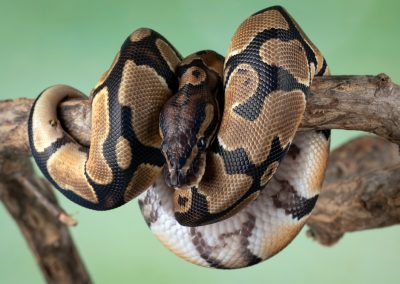
The Everglades lost 99% of its raccoons to Burmese pythons.
Now Florida is watching the same horror story start over – in a brand new location.
A new breeding colony just confirmed in Charlotte County means the invasion is no longer a South Florida problem.
One Woman Against a Thousand Snakes
Amy Siewe quit a 13-year real estate career in 2019 to become a full-time python hunter.
She goes by "the Python Huntress."
She works the Everglades several times a week – standing on a custom snake deck built onto her truck, scanning water and grass alongside her trained dog Dixie.
What she sees out there should scare every Floridian.
"They eat 98% of the mammals in parts of the Everglades," Siewe told Fox News. "So they're really devastating our ecosystem."
The numbers back her up.
Since the 1980s, raccoon populations in python-invaded areas of the Everglades have collapsed by 99.3%. Opossums down 98.9%. Marsh rabbits, cottontail rabbits, and foxes – locally extinct from most areas where pythons have taken hold.
https://twitter.com/1Nicdar/status/2124112739886895178?a=NpnBhAyrM9SDs9R4m4Q&s=20
The snakes also prey on white-tailed deer, wild hogs, and alligators.
Over 27,000 Burmese pythons have been removed from Florida since 2000 – and experts say that number barely scratches the surface.
"When we find one python, there could be up to a thousand more that we're not seeing," Siewe said.
She estimates the snakes spend 85% of their time completely motionless in hard-to-reach terrain.
Biden Tried to Lock the Hunters Out
Before we get to Charlotte County, you need to know what just happened at Big Cypress.
Big Cypress National Preserve is python ground zero in federal territory – the remote western Everglades swampland where hunters have made the most progress.
In 2024, the Biden administration's Interior Department – led by Secretary Deb Haaland – pushed a federal wilderness designation for Big Cypress that would have locked hunters out entirely.
Florida's congressional delegation fought back.
Rep. Byron Donalds and 17 Florida colleagues wrote Haaland directly, warning that a wilderness designation would "supercharge the spread of invasive species" and cut off the hunters keeping the python population in check.
Biden's team eventually backed down – but only after DeSantis and Florida's Republicans forced the issue.
The federal government spent four years making the python problem harder to solve, and Florida's native wildlife paid for it.
The Charlotte County Alarm
Here is what just changed.
Florida Fish and Wildlife officials confirmed this year that a new, established breeding population of Burmese pythons has taken hold in Charlotte County – north of Naples and Fort Myers on Florida's Gulf Coast.
A separate population is now being tracked in Brevard County – farther north than anyone expected.
https://twitter.com/PiQMarkets/status/1932425364028239902?a=mOhp8T2j52dscrrh_Ug&s=20
Officials believe these colonies are not connected to the Everglades population – meaning irresponsible pet owners released snakes, the animals bred, and a new invasion is now underway in locations with no containment infrastructure.
Siewe explained exactly why that is catastrophic.
"The problem with the pythons is that you don't even know that they're there until it's way beyond your control."
By the time Charlotte County confirms ten pythons, there may already be ten thousand.
That is not a figure of speech – it is how the Everglades invasion worked.
A handful of escaped pets after Hurricane Andrew in 1992 became the tens of thousands of snakes now spread across more than a thousand square miles of South Florida.
The Clock Is Already Running
Florida has been fighting back harder than ever.
Governor DeSantis invested $2 million in the state's PATRIC program in 2025 – the Python Action Team Removing Invasive Constrictors – and secured expanded access to federal lands inside Big Cypress that Biden's team spent years restricting.
The result: over 2,700 pythons removed in just the first eight months of 2025, nearly matching the entire previous year's total by August.
The 2026 Python Challenge drew hunters from across the country competing for $25,000 in prize money, removing 280 snakes in ten days.
It is an impressive response.
It is also not enough.
Female Burmese pythons lay 20 to 40 eggs per clutch – the largest ones lay over 100.
For every snake removed in a ten-day competition, dozens more are breeding in terrain where even trained dogs and elevated truck platforms cannot locate them.
Charlotte County is the warning the Everglades never got.
Florida's hunters are ready.
The only question is whether Washington gets out of the way long enough to let them work.
Sources:
- Amy Galo, "Invasive Burmese pythons push farther north into Florida as hunters race to stop ecological devastation," Fox News, November 25, 2026.
- Florida Governor's Office, "Governor Ron DeSantis Highlights Success of Everglades Python Removal Program," flgov.com, October 21, 2025.
- Florida Fish and Wildlife Conservation Commission, "2026 Florida Python Challenge kicks off July 10," myfwc.com, July 10, 2026.
- Rep. Byron Donalds et al., letter to Secretary Deb Haaland, donalds.house.gov, 2024.
- Florida Museum of Natural History, "Florida vs. the Burmese Python: How an Invasive Giant Is Changing the Sunshine State," floridamuseum.ufl.edu.