Last summer, a 4-foot-11 woman named Taylor Stanberry waded barefoot through the Everglades at night and killed 60 giant pythons in 10 days.
Now Florida is paying the next person to beat her record.
Starting July 10, the 2026 Florida Python Challenge puts $25,000 on the table – and you don't have to be from Florida to collect.
The Everglades Your Grandfather Fished Is Gone
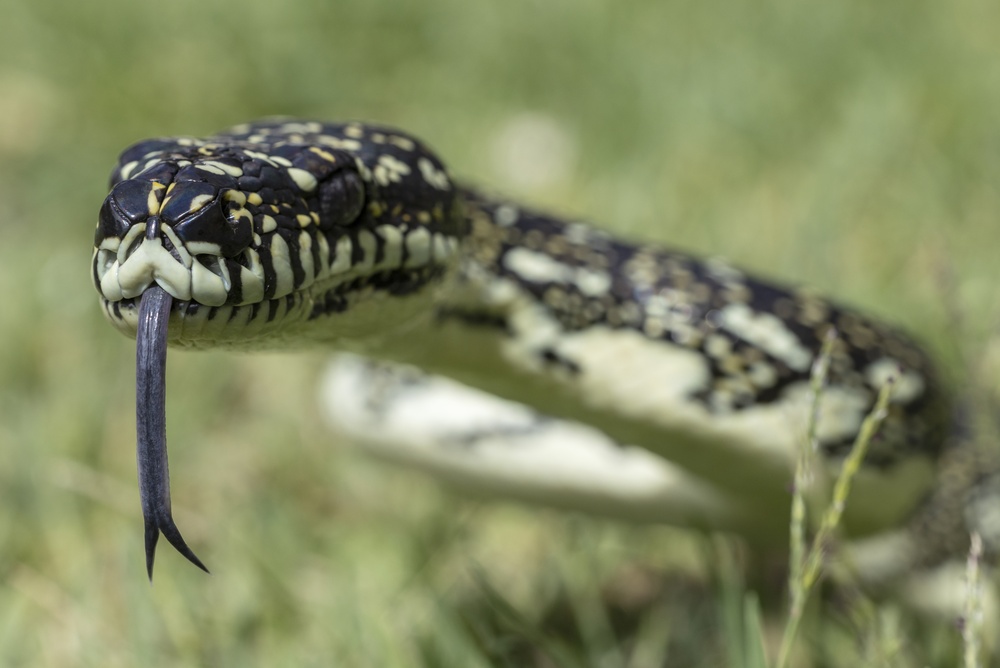
Burmese pythons have no business being in Florida.
They came from Southeast Asia, escaped from exotic pet facilities during Hurricane Andrew in 1992, and found the Everglades to be a paradise with no natural predators and an endless buffet of native wildlife that had no idea what was coming.
A single female lays up to 100 eggs at a time.
Conservative estimates put their current population in the Everglades at tens of thousands – and that number keeps climbing.
And what they've done to the wildlife your grandfather used to see on the water is nothing short of a biological catastrophe.
https://twitter.com/Chars_Radio/status/2069220278534635572?s=20
Since pythons took hold in the late 1990s, raccoon populations in the Everglades have crashed 99.3 percent.
Opossums are down 98.9 percent.
Bobcats down 87.5 percent.
Marsh rabbits – gone.
Cottontail rabbits – effectively gone.
Foxes – gone.
When the USGS reintroduced a rabbit population into Everglades National Park to study the problem, pythons had killed every single one within 11 months.
Scientists now say complete eradication is likely impossible.
That means the only option is to keep fighting – which is exactly what Florida decided to do.
Here Is How You Get Paid to Fight Back
The 2026 Florida Python Challenge runs July 10 through July 19, hosted by the Florida Fish and Wildlife Conservation Commission and the South Florida Water Management District, with Everglades National Park back as an official partner.
Eight designated competition zones are open across South Florida.
The prize is simple: $10,000 to whoever kills the most pythons, with additional cash prizes for most pythons and longest python across novice, professional, and military categories.
You register at FLPythonChallenge.org for $25, complete a 30-to-45-minute online training, and show up.
No hunting license required.
https://twitter.com/Sean37025291061/status/2067573673586827373?s=20
No Florida residency required.
Last year, 934 people from 30 states and Canada showed up and set a competition record – 294 pythons removed in 10 days.
And the snakes keep coming.
That's Not a Bureaucracy Fixing It
Think about what this program actually is.
Florida looked at an ecological disaster created by decades of lax oversight, shrugged off the academic hand-wringing about whether anything could be done, and said: we're going to pay citizens cash money to fix it.
No federal mandate.
No billion-dollar bureaucratic program.
No waiting for Washington to finally get around to it.
https://twitter.com/RonDeSantis/status/2068774875515195882?s=20
Governor DeSantis has backed this program year after year, and the results are real – over 27,000 pythons removed from Florida's environment since 2000, more than 14,000 pulled by state contractors since 2017 alone.
Taylor Stanberry proved last summer what one determined American can do in 10 days barefoot in a swamp.
In areas where hunters work consistently, she's already watching bobcats and rabbits edge back into territory the pythons took from them.
That's not an EPA report.
That's not a federal wetlands initiative.
That's Americans with headlamps taking back wild Florida one snake at a time.
Register at FLPythonChallenge.org before July 19 and go earn your $10,000.
Sources:
- Florida Fish and Wildlife Conservation Commission, "Registration is now open for the 2026 Florida Python Challenge," FWC, May 19, 2026.
- Tampa Free Press, "Slithering Toward A $10,000 Grand Prize: 2026 Florida Python Challenge Begins July 10," Tampa Free Press, June 22, 2026.
- FWC, "FWC announces results and winners of the 2025 Florida Python Challenge," FWC, August 13, 2025.
- FWC, "FWC announces results and winners of the 2024 Florida Python Challenge," FWC, August 2024.
- U.S. Geological Survey, "How have invasive pythons impacted Florida ecosystems?" USGS.gov.